
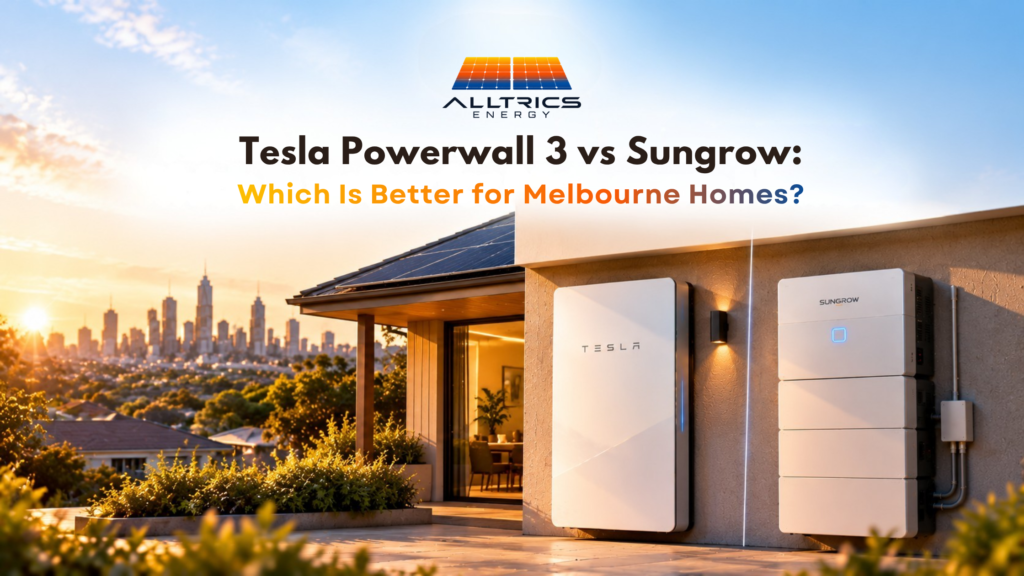
When it comes to residential batteries, two names dominate Australian conversations: Tesla Powerwall and Sungrow.
Both are solid. Both are installed in hundreds of Melbourne homes. But they’re different in ways that matter.
Here’s how to figure out which is right for you—without the marketing hype from either side.
The Quick Comparison
| Feature | Tesla Powerwall 3 | Sungrow SH5/SH10 |
|---|---|---|
| Capacity | 13.5 kWh (fixed) | 5/10 kWh (modular) |
| Usable capacity | ~10.8 kWh (80%) | ~4/8 kWh (80%) |
| Installed cost (10kWh equiv) | $15,500–$16,500 | $13,500–$15,000 |
| Warranty | 10 years (unlimited cycles) | 10 years (8,000 cycles) |
| Efficiency | 97% | 95–96% |
| Backup capability | Yes (built-in) | Yes (with backup switch) |
| Smart software | Excellent (Tesla app) | Good (Sungrow app) |
| Scalability | Limited (1 unit max standard residential) | Very good (stack multiple units) |
| Made in | USA/China | China |
| Common in Australia | Very common | Growing fast |
Tesla Powerwall 3: The Premium Choice
What You’re Getting
The Powerwall 3 is a sleek, AC-coupled battery (~1.4m tall, wall-mounted). It integrates directly with a compatible inverter to charge and discharge.
13.5 kWh capacity is fixed—you can’t buy a 5 kWh or 20 kWh version. You get one size.
Pros
1. Excellent software & monitoring
Tesla’s app is genuinely polished. You can see real-time generation, consumption, battery charge, and exports from anywhere. The interface is intuitive.
2. Long warranty with unlimited cycles
10 years, unlimited charge cycles. This is industry-leading. Tesla’s betting their battery will outlast the warranty.
3. Grid services (Tesla-only feature)
In future, Powerwalls can participate in grid stabilization programs. You might earn money by letting Tesla dispatch your battery during peak times. This is emerging, but it’s Tesla-unique.
4. Seamless backup
If the grid fails, backup switches over instantly. No microgrids or complex setups needed.
5. Aesthetics
It looks modern, fits on a wall, and doesn’t dominate your garage like an industrial box.
Cons
1. Fixed capacity
You can’t buy just 5 kWh. A single Powerwall is 13.5 kWh. For smaller homes, that’s oversizing. For larger homes, you’d need multiple Powerwalls (~$28,000 for two), which gets expensive.
2. Higher upfront cost
For equivalent capacity, a Powerwall is roughly $1,500–$2,000 more than Sungrow. Not huge, but real.
3. Inverter requirements
Not all inverters integrate smoothly with Powerwall. You might need a specific hybrid inverter or a Tesla Gateway (additional cost). With some existing systems, integration can be messy.
4. Tesla dependency
You’re tied to Tesla’s software, support, and ecosystem. If Tesla deprioritizes battery support in Australia (they’ve scaled back operations before), you might face support challenges.
5. Real-world cycle claims
While the warranty is unlimited cycles, some users report the actual battery capacity (how much real kWh you get) degrades over time. Not dramatically, but it’s worth knowing.
Melbourne Reality: Powerwall
Who chooses it: Affluent homes that value aesthetics and software polish. Homes with existing Tesla EVs. Tech-forward buyers.
Real cost for Melbourne: $15,500–$16,500 installed after rebates (typically $3,000–$4,000 rebate depending on eligibility).
Payback: 9–12 years for a typical home with good evening load.
Sungrow: The Practical Choice
What You’re Getting
Sungrow batteries are modular. The SH5 is 5 kWh; the SH10 is 10 kWh. You can buy one, or stack two SH5s for 10 kWh. The battery sits in a weatherproof box (looks industrial, but takes less wall space).
Sungrow is also Chinese-made (so is Tesla’s at this point, but it’s worth mentioning).
Pros
1. Modularity & flexibility
Only need 5 kWh? Buy one. Want to add more later? Bolt on another. This is genuinely clever for homes where battery needs might evolve.
2. Lower upfront cost
A 10kWh Sungrow setup typically costs $1,500–$2,000 less than a Powerwall 3 equivalent. Small difference per system, but meaningful.
3. Broad inverter compatibility
Sungrow batteries work with a wider range of hybrid inverters (Sungrow, Fronius, SMA, etc.). You have more flexibility if you’re retrofitting into existing systems.
4. Proven track record
Sungrow is one of the world’s largest battery manufacturers (used globally). It’s been in residential Australian homes since 2018. Plenty of data on real-world performance.
5. Good warranty, realistic
10-year warranty with 8,000 cycles (realistic cycle count, not unlimited). Transparent about battery degradation over time.
Cons
1. Software not as polished
The Sungrow app works, but it’s not as intuitive as Tesla’s. Monitoring is functional but less “wow.”
2. Backup requires extra hardware
To get seamless grid-failure backup, you need an additional backup switch (~$800–$1,200). This adds complexity and cost compared to Powerwall’s built-in backup.
3. Less sexy
It’s a box in your garage. Not on anyone’s “cool tech” radar. If aesthetics matter, this might not be it.
4. Scalability costs money
While you can buy 5 kWh now and add 5 kWh later, doing so means two units, two warranties to manage, and less clean integration than a pre-sized system.
5. Australian support
Sungrow support in Australia is good but not as seamless as Tesla’s (partially because Tesla owns the customer experience end-to-end; Sungrow relies on installers).
Melbourne Reality: Sungrow
Who chooses it: Practical homes focused on cost. People adding batteries to existing systems (better compatibility). Budget-conscious families. Homes that might expand later.
Real cost for Melbourne: $13,500–$15,000 installed after rebates (same rebate opportunities as Powerwall).
Payback: 8–11 years (slightly faster than Powerwall due to lower cost).
Real Melbourne Scenarios
Scenario 1: Alex, Fitzroy (Early adopter, aesthetic-focused)
- Wants the latest tech, willing to pay premium
- Cares about app experience and monitoring
- Already has Tesla Model 3
- Home has available wall space
- Choice: Tesla Powerwall 3
- Why: Integration with car, premium software, aesthetics matter, cost is secondary
- Trade-off: Paying more for experience
Scenario 2: Gretal & Marcus, Balwyn (Budget-conscious, practical)
- Want battery savings but cost matters
- Existing system is Sungrow inverter (adding battery later)
- Plan to stay 10+ years
- Prefer practical, proven approach
- Choice: Sungrow SH10
- Why: Better compatibility, lower cost, proven reliability, good payback
- Trade-off: Less fancy app, but works perfectly
Scenario 3: Nina, Outer East (Flexibility-minded)
- Uncertain about battery size needs
- Smaller home (maybe 5 kWh is enough for now)
- Might upgrade later
- Cost is significant factor
- Choice: Sungrow SH5 (with plan to add SH5 later)
- Why: Start small, proven scalability, modular approach fits uncertainty
- Trade-off: Two units instead of one, but right-sized upfront
Scenario 4: James, St Kilda (Backup priority)
- Grid reliability is his main concern (home office, unreliable suburb)
- Wants seamless backup
- Willing to pay for peace of mind
- Choice: Tesla Powerwall 3
- Why: Built-in backup, instant failover, no extra hardware needed
- Trade-off: Paying premium for failover simplicity
What About Other Brands?
Quick mention of alternatives worth considering:
AlphaESS (Smile S5/S10): Australian-friendly, modular like Sungrow, solid warranty. Cost slightly higher than Sungrow but lower than Tesla.
LG Chem (RESU): Excellent reputation, common in Asia, less common in Australia now due to limited availability.
Generac PWRcell: Premium US brand, scalable, very expensive for Australia. Niche market.
Huawei (Luna2000): Growing presence, modular, good app, cost-competitive. Worth considering in broader comparison.
For Melbourne specifically: Sungrow and Tesla dominate because of installer expertise and parts availability. AlphaESS is gaining traction. Others are niche.
The Financial Reality
Sungrow is cheaper; Powerwall has better resale/integration benefits.
Over 10 years:
- Sungrow: Lower cost, slightly faster payback, proven Australian track record
- Powerwall: Premium cost, better software, unique grid services potential (emerging), better integration with EV owners
Difference in total savings: Maybe $100–$200/year (negligible). The choice is mostly about philosophy—budget-first (Sungrow) or tech-first (Powerwall).
Genuine Trade-offs
Choose Sungrow if:
- Budget is a real factor
- You’re adding to existing Sungrow/Fronius inverter
- You want proven, practical technology
- You might want to expand later
Choose Powerwall if:
- You prioritize software experience
- You have a Tesla EV (ecosystem integration)
- Backup simplicity matters
- You value long-term grid-services potential
- You’re installing fresh (not retrofitting)
One More Honest Thing
Both are good batteries. Melbourne homes have hundreds of each, and both are delivering real savings. The difference isn’t “right vs. wrong.” It’s philosophy: practical vs. premium.
Neither is likely to fail you. Both will save money. The choice comes down to your values and constraints.
Next Steps
Ready to understand which battery makes sense for your home? We’ll assess your situation, show you real costs for both options, and recommend which aligns with your budget and priorities—without bias toward one manufacturer.
Book a free consultation. We’ll compare both in detail for your specific home and situation.

