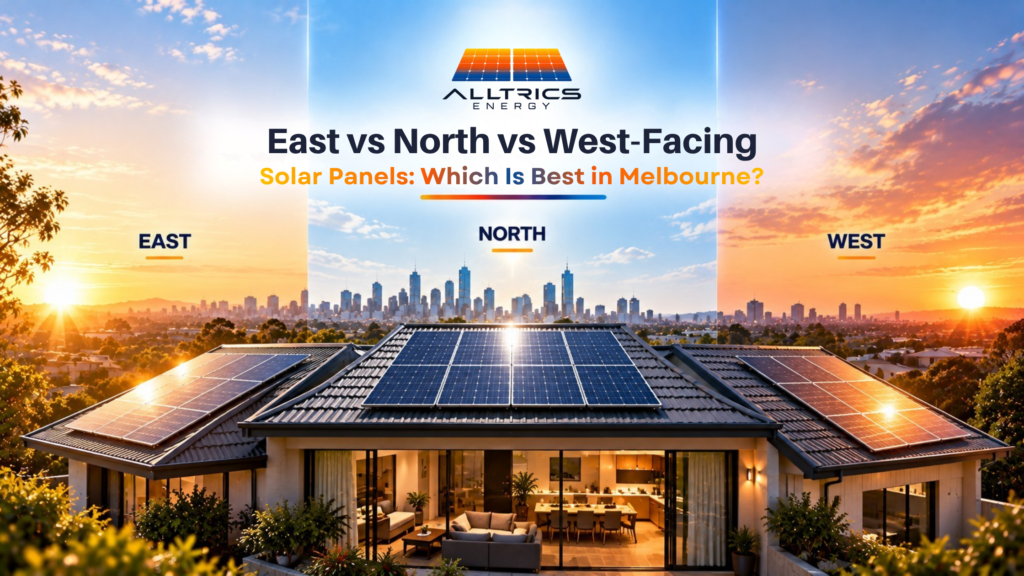
Here’s the most common constraint: “My roof only faces east” or “I’ve got a bit of north, but mostly west.”
So the question becomes: Which direction should I face my solar panels, and how much does orientation actually matter?
The honest answer: North is best, but east or west can still make you real money. And sometimes, the direction matters less than you’d think.
Let me break down the Melbourne reality.
The Orientation Scale (Australia-Wide)
In Australia, solar generation follows the sun. The sun travels east to west, reaching its highest point (south) in the north. This means:
North-facing = Most generation
East-facing = Morning generation
West-facing = Afternoon generation
South-facing = Least generation
In Melbourne specifically:
North-Facing (The Gold Standard)
- Annual generation: 100% baseline
- Daily pattern: Steady from morning to evening, peaking around 1pm
- Melbourne impact: Optimal year-round; no weather or season penalty
- Who benefits: Homes with simple roofs, straight south-facing aspect
East-Facing (The Underrated Option)
- Annual generation: 85–90% of north
- Daily pattern: Peaks in morning (6am–11am), drops by afternoon
- Melbourne impact: Great for morning consumption; less useful for evening peak demand
- Who benefits: Homes with east-facing roofs; families awake/at home in morning
West-Facing (The Emerging Favorite)
- Annual generation: 85–90% of north (similar to east)
- Daily pattern: Peaks in afternoon (2pm–6pm), minimal morning generation
- Melbourne impact: Aligns perfectly with summer evening aircon peak
- Who benefits: Homes with west-facing roofs; strong evening peak; batteries (store afternoon generation for evening use)
Split Installation (East + West)
- Annual generation: 95–98% of north-facing
- Daily pattern: Balanced across day
- Melbourne impact: Excellent for homes with enough roof space
- Who benefits: Homes with good east and west roof access; want to maximize without adding much extra area
South-Facing (Don’t Bother)
- Annual generation: 30–40% of north
- Reality: Waste of money and roof space
- **Melbourne: Skip it completely
Real Melbourne Generation Comparison
Let’s use actual Melbourne data for a 6.6kW system:
Scenario: January (Summer, Clear Day)
North-facing:
- 6am–7am: 0.2 kW
- 9am–12pm: 5.5–6.0 kW (peak)
- 3pm–6pm: 2–3 kW
- Daily total: 28 kWh
East-facing:
- 6am–8am: 4.0–5.5 kW (early peak)
- 10am–12pm: 3.5–4.0 kW (dropping)
- 3pm–6pm: 0.5 kW
- Daily total: 22 kWh (79% of north)
West-facing:
- 6am–8am: 0.5 kW
- 10am–12pm: 3.5–4.0 kW
- 3pm–5pm: 5.0–5.5 kW (peak)
- 6pm: 1.5 kW
- Daily total: 23 kWh (82% of north)
Split (3.3kW east + 3.3kW west):
- 6am–8am: 2.2 kW (from east)
- 10am–2pm: 4.0–4.5 kW (combined)
- 3pm–6pm: 2.2 kW (from west)
- Daily total: 26 kWh (93% of north)
Scenario: July (Winter, Mixed Cloudy/Clear)
North-facing:
- Generation: 12–15 kWh on clear days
- Most generation between 9am–3pm
East-facing:
- Generation: 10–12 kWh on clear days
- Front-loaded morning (clouds often roll in by afternoon)
West-facing:
- Generation: 10–12 kWh on clear days
- Often misses generation if afternoon clouds hit early
Split:
- Generation: 12–14 kWh (hedges weather risk)
Key insight: Winter matters. West-facing gets penalized more in Melbourne winter because afternoon clouds are common. East-facing fares slightly better (morning generation locks in before clouds).
Melbourne’s Actual Roof Realities
Here’s where theory meets practice:
Most Melbourne Homes Have Gabled Roofs
Two slopes: one facing northeast, one facing northwest. They’re rarely perfectly north.
This means:
- Northeast slope: ~15° off north, still gets 95%+ of north performance
- Northwest slope: ~15° off north on the other side, still gets 95%+ of north performance
Reality: If your roof is just tilted a bit east or west of north, don’t panic. The difference is negligible.
East + West Split is More Common Than You’d Think
Gabled roofs mean you naturally have both east and west exposure. Installers often put panels on both slopes:
- Half on east slope (morning generation)
- Half on west slope (afternoon generation)
- Result: More balanced daily generation, nearly as good as north-only, but spread across more hours
This is elegant because it:
- Uses available roof space efficiently
- Spreads generation across the day (less export during peak, more self-consumption)
- Hedges against partial shading (if one side gets shaded, the other side still generates)
The Battery Game-Changer
Here’s where orientation becomes really important:
Without a battery:
- North-facing is still best (maximizes total generation)
- East/west matters less (you use what’s generated; excess exports at lower rates)
With a battery:
- West-facing becomes more attractive (afternoon generation matches when battery charges for evening use)
- East-facing is still good (morning generation can partially power morning loads, leaving more solar for battery)
- Split east+west is nearly optimal (balanced charging opportunity throughout day)
Example: Sarah’s household with battery
- East panels generate 8am–12pm (power morning devices, charge battery partially)
- West panels generate 1pm–5pm (maximize battery charge before evening peak)
- Evening: Use stored battery power instead of grid
- Result: West-facing orientation with battery is almost as efficient as north-facing
This is why west-facing systems have become more popular in battery-era solar. The afternoon peak aligns with evening peak demand when you’ve got storage.
The Roof Space Question
This often outweighs orientation:
Scenario: You can fit 18 north-facing panels or 24 east+west panels.
- 18 north: 6.6kW → 95+ kWh/day in summer
- 24 split (east+west): 8.8kW → 100+ kWh/day in summer
The split wins, even though individual panels perform slightly worse, because you have more total capacity.
Moral of the story: If you can fit more panels going east+west than going north-only, the split usually wins.
Real Melbourne Examples
Example 1: James, Balwyn (Simple North-Facing Roof)
- Roof orientation: Perfectly north-facing
- Space available: 20 panels
- Recommendation: 6.6kW north-facing
- Why: Optimal orientation, plenty of space, straightforward installation
- Expected: 24–26 kWh/day (summer average)
Example 2: Lisa, Footscray (East+West Gabled Roof)
- Roof orientation: Northeast + Northwest slopes
- Space available: 10 panels east, 14 panels west
- Recommendation: 3.3kW east + 4.6kW (split system = 7.9kW total)
- Why: Uses available space, east for morning consumption, west for afternoon battery charging
- Expected: 25–27 kWh/day (summer), well-balanced throughout day
- Extra benefit: Battery pairs naturally with west orientation
Example 3: Marcus, Dandenong (West-Facing Only)
- Roof orientation: West-facing only, heavily shaded on east
- Space available: 16 panels west
- Existing consumption: High evening aircon (summer, winter)
- Recommendation: 5.3kW west-facing + plan for battery
- Why: Afternoon/evening generation aligns with peak demand; battery (future) will capture afternoon surplus for evening peak
- Expected: 18–20 kWh/day (summer) from west
- Note: Smaller than ideal, but orientation + battery strategy makes it work
Example 4: Nina, Outer East (Shaded East Side, Clear North/West)
- Roof orientation: North, west clear; east heavily shaded by tree
- Space available: 14 panels north, 8 panels west
- Recommendation: 4.6kW north + 2.6kW west (7.2kW total)
- Why: Avoid shaded east; use clear north + whatever west can offer
- Expected: 23–25 kWh/day (summer)
- Note: Not perfect, but works with actual site constraints
Shading: The Orientation Killer
Here’s the thing most installers gloss over: orientation matters way less than shading.
A west-facing roof in full sun generates 90% of what a north-facing roof in full sun generates.
But a north-facing roof that’s 20% shaded (partial tree cover, building edge, chimney) generates only ~80% of its potential, which is now lower than the fully sunny west roof.
Rule: Clear orientation beats theoretically better orientation with shading.
This is why site assessment is critical. We map shading hour-by-hour. It’s not just “is there a tree?”—it’s “how much does that tree block in summer vs. winter?”
The Financial Impact
Over 25 years, how much does orientation really matter?
North-facing 6.6kW: $2,250/year savings (avg)
West-facing 6.6kW: $1,900/year savings (avg, no battery)
Difference: $350/year
That’s real money, but it’s not massive. Over 25 years, it’s $8,750 difference. On a $6,500 system, that’s about 1.3 years extra payback time.
With a battery:
West-facing 6.6kW + battery: $2,100/year savings (afternoon charging + evening use)
Difference shrinks dramatically. Battery orientation advantage is huge.
The Practical Take-Away
Best to worst for Melbourne:
- North-facing (95–100%) – Optimal, use it if available
- Split east+west (93–98%) – Nearly optimal, often best when you have room
- West-facing only (85–90%) – Good, especially with battery
- East-facing only (85–90%) – Good, especially for morning consumption
- Northeast or northwest (90–95%) – Still very good (minor tilt off perfect north)
Don’t compromise on shading to get orientation. Sunny west beats shaded north every time.
Next Steps
The only way to know what orientation makes sense is a site assessment.
We’ll:
- Map your roof aspect (north? East/west split? Tilts?)
- Assess shading hour-by-hour (not just “is there a tree?”)
- Calculate orientation-specific generation for your exact location
- Recommend the best panels + orientation combo for your roof and consumption
Some homes naturally favor north. Others (especially with batteries) actually favor west. You’ll know which is right for your home.
Book a free solar site assessment. We’ll show you real generation numbers for your actual roof orientation and shading—not generic averages.

